
Tell Us A Story.
How Kier Starmer (or anyone) can win by losing.

In the wake of Labour’s recent catastrophic election results in the Welsh and Scottish national and English local elections a lot of the commentary has focused on the Prime Minister’s failure “to tell the story” of what his government has achieved. His other shortcomings get discussed, his private arrogance, public lack of charisma, his failure to take responsibility for his many short sighted choices, yet often it feels like all of these could be overcome if only he was a better storyteller. But what is a good storyteller?
I work in what is often misconstrued as a visual medium. As a result the injunction that good storytellers “show don’t tell” often gets interpreted as “do it with pictures not dialogue”, but film and TV is not a visual medium. As I’ve mentioned before, if I could coin a catchall word I would still lean towards “movies” because the element the medium values most, more than sound, more than image, is motion, is action. “Show” does not mean visualise, it means demonstrate.
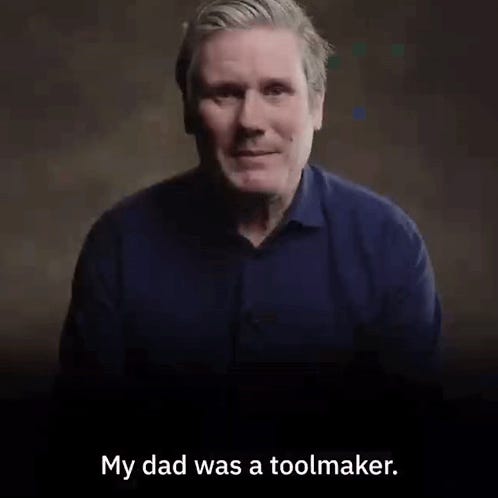
The Labour Party website has a “delivery feed” which lists, in iPhone optimised format, all their achievements since the landslide win of ’24. Some of these may warm your heart, many feel like stretching a point (can you be to said to have “delivered” “bearing down” on violence against women and girls?) It’s a bad tv pitch: full of plot, lacking in story, telling not showing. Election wins are not rewards for work done, rather, like the best tv pitches, they are built on the promise of what happens next. A plan, like a plot, is easy for sceptics to unpick, far more compelling to suggest what happens next through your characters’ behaviour. When first the pressure began to mount, Starmer told everyone “My father was a tool maker” but it was never clear what that meant for season 2.
A leader is a totem. They are the main character. The story runs through them. They embody it. By the end Thatcher spoke like the Queen but we all knew she was a shop girl. She was a fake but weren’t we all? She lived out a story of sleepless ceaseless insatiable hunger, the thousand petty resentments of a nation that still taught its children to sing “two world wars and one World Cup”. In contrast Blair was easy. He didn’t seem to have to work for it and neither would we. His oratory is the epitome of the 90s style, his words not meaningless but meaning less than the moments they capture. “She was the People’s Princess” “I feel the hand of history upon our shoulder, I really do” “Don’t look back in anger, I heard you say” “All the people, so many people, and they all go round and round through their park life”. Yes mate, yes mate, what?
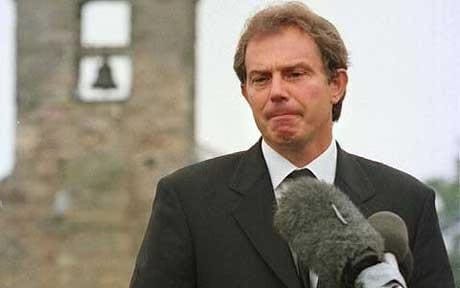
The Starmer project’s attempt to repeat that trick misunderstood the change in the world but also the story Blair embodied. By the time he came to power we’d already won the Cold War by not losing it. No trenches, no bombs but no victory either, the Berlin Wall fell less by design than mistake. Blair was the charming young man who’d won the national lottery and was going to share the proceeds. Things can only get better.
Starmer also won a war by not losing. For 4 years he and McSweeny carried that Ming vase knowing that all they had to do was not tell any story that might upset anyone at all. Of course he is not a good a storyteller, that’s the point. The emptiness of Starmer was what suited him for the task of becoming Prime Minister, even if it is has been what has left him so unsuited to the task of being one.
Starmer came to power with 9.7 million votes, less than a fifth of all voters. We all know our winner takes all voting system is ill suited to multi-party democracy but the problem isn’t so much the maths as the fictions we persist on weaving from them. In the wake of his landslide Starmer is said to have told his cabinet that they owed their jobs him and his victory. Of all the stories to tell this was the most deluded.
Starmer’s greatest strength is still his opponents’ weaknesses. Perhaps in time this can become his narrative, persisting like a cough or light rain. Replacing him is constitutionally complex and the spoils of victory have never looked more spoilt. The one positive for a new PM arriving mid-term with no mandate, leading a party that barely had one in the first place, is that they would be uniquely placed to tell a story of real reform.
The persistence of First Past The Post voting hinges on there being no benefit to changing a system that has just put you in power. But should Burnham, Miliband or Rayner become the 5th PM in five years they can have no realistic hope of fairing better under this system than a proportional alternative. Electoral Reform would be cynical but also aspirational, the most democratic move since Brexit. It would rule out a future Labour majority but no one beyond Wes Streeting imagines that happening and he still thinks this song is about him. Instead it would, most likely, open up the left of centre coalition the actual majority of the country has always voted for.
I’m sure whoever leads Labour will be too swayed by the broken logic that what voters want is the same chaos better run. However fractured our politics looks, the electorate are saying very clearly what they really want. It’s reform or Reform.
I’ve barely mentioned him in this but his name fills the air every time I turn on the news and thanks to Cariad Lloyd I hear this every time.