
Refusing The Call.
Considering the victims of the hero's journey.

There is, of course, a lot to say about Pete Hegseth’s recent statement “We didn’t start this war, but under President Trump we are finishing it”. That legally his job title remains Secretary of Defence yet the administration still insist he is in fact “Secretary of War” is the least glaring irony of this pronouncement which came two days after the Americans walked away from talks where their Omani hosts had described peace as “within reach”. However what interests me is why Hegseth went to the effort.
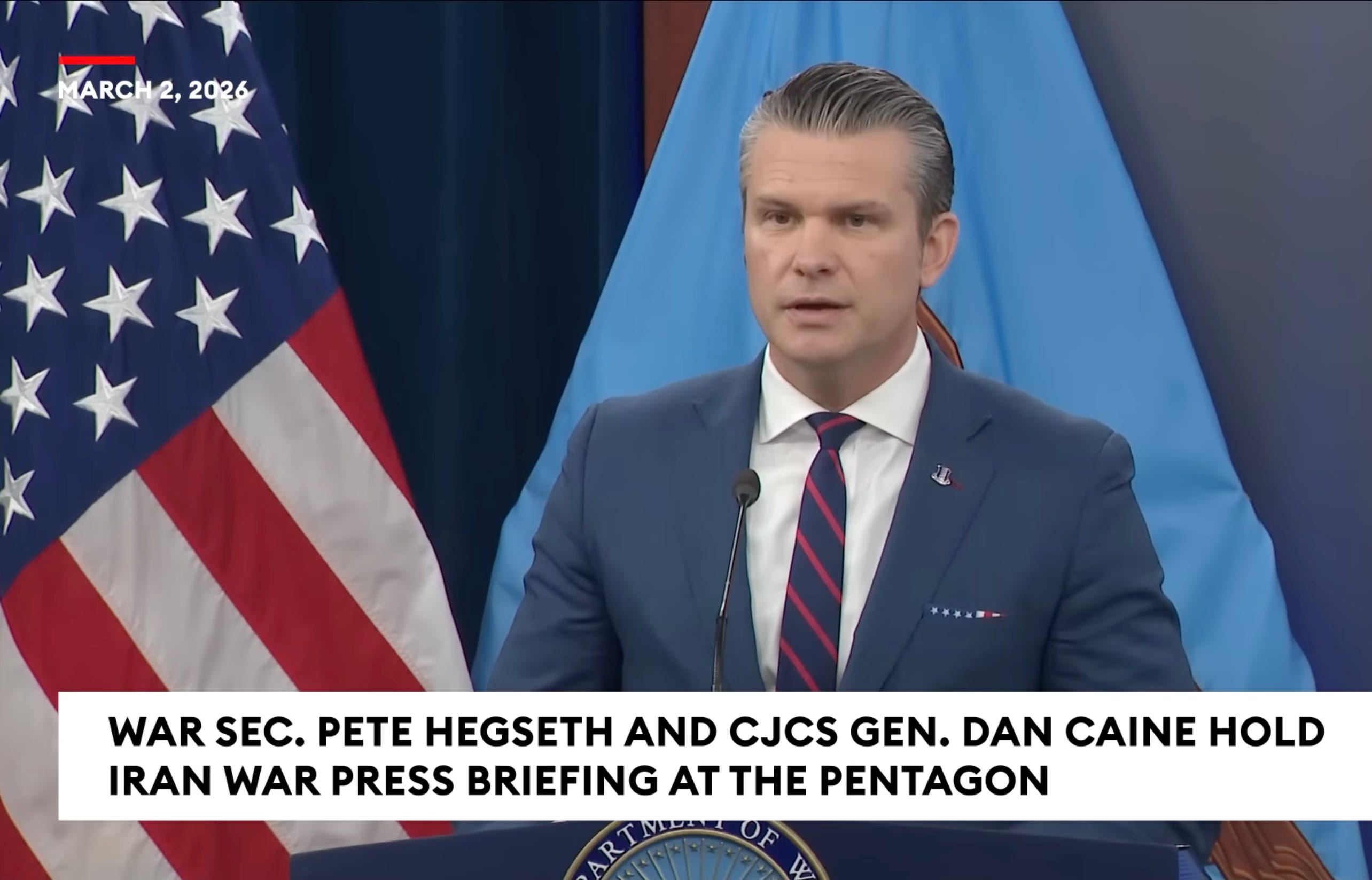
Of course, perhaps he didn’t. The text of Hegseth’s press briefing of March 2nd smells of Chat-GTP with its love of redundant hyphens and heavy-handed rhetorical swivels like…
“Turns out the regime who chanted “Death to America” and “Death to Israel” was gifted death from America and death from Israel.”
or…
“This is not a so-called regime-change war, but the regime sure did change…”
Taking compositional tips from an LLM assistant is to constantly pull your thoughts back to the arithmetic mean. Certainly Hegseth’s pronouncements lack the poetry of previous American military statements. But whether divined by algorithm or whatever sweaty human urge propels the Secretary of War, its still the case that when making the case for this conflict Hegseth felt he had to render the tangled 47 year history of post-Shah Iranian American relationships so as to cast the nuclear armed superpower who fired first as the blameless injured party. Again, why bother?
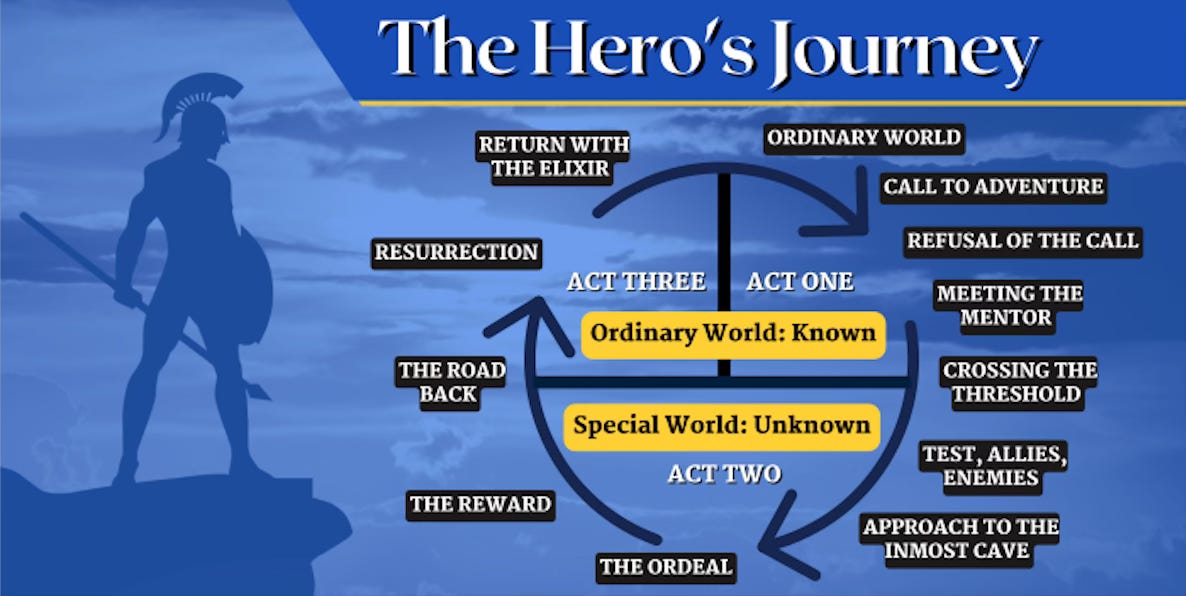
Joseph Campbell first published The Hero With A Thousand Faces, his exigis on what he termed the monomyth, in 1949. Drawing on the work of psychoanalysts including Freud, Jung and Otto Rank as well ethnographers James George Frazer, Franz Boas and Arnold Van Gennep, Campbell outlined patterns he suggested repeated across diverse mythologies including the narratives of Jesus, Mohammed, Osiris and Prometheus. Campbell codifies these as “The Hero’s Journey”, a story arc through which an ordinary man (and yes, it always is) ventures from home, is taught to confront his darkest fear and, changed by the experience, returns to restore harmony.
There is a tension in Campbell’s work that stems from his sources. He shares Boas’ equalising desire to demonstrate our globally shared cultural roots, perhaps to a point that now looks like overdone cultural relativism. Yet he also inherits the eurocentrism that plagues Frazer’s “The Golden Bough”. Taken together these start to feel like a project where the monomyth is a monoculture, where we diminish the otherness of others, preferring to retell ancient stories so that everyone behaves like us; the ethnographic version of “oh, I don’t see skin colour.”
I can’t find the exact quote but we’re talking about myths so let’s run with my memory of something I think Hilary Mantel might have said about writing about the past, to the effect that we must always remember that people are always the same as us and totally different at the same time. It is a disservice to collapse the strangeness of other times and other places.
Campbell’s other key ethnological source was Arnold Van Gennep whose best known work “The Rites of Passage” set out three phases of ritual growth which come to us via Campbell as “Departure”, “Initiation” and “Return”. For storytellers the first of these breaks down into three crucial steps, the expositional laying out of the ordinary world, the arrival of a problem, often referred to as “The Call To Adventure” which has to be followed by a hopeless struggle to just go back to the start and forget it all, known as “The Refusal of the Call”.
This step is essential but odd. It reminds me of the phoney pantomime of the would-be Prime Minister coyly refusing be drawn about their ambitions, or how the MP who challenges their leader is rarely the one who then takes their place. It is especially camp in an adventure story, I mean, who are we kidding? We all know why we’re here, we all know what’s going to happen, why suddenly pretend the hero is not going to enter the labyrinth? Luke Skywalker was never going to sniff the drink and murders on Obi Wan’s breath and change his mind about being a farmer. Conan the Barbarian will not spend an easy day in bed. So why? Why do we need our heroes to be dragged kicking and screaming into the action? Why do we need to have at least had it said out loud that “We did not start this war”?
The “refusal of the call”, however coyly performed, however camp it feels, is an essential part of the process of triggering the audience’s empathy. No one cares about the problems you have chosen. The rich kid faking the poor kid’s attitude is vilified. To trigger the audience’s empathy your character needs to be in pain, that can be physical, emotional, psychological or intellectual but it also has to be unfair.
Intellectually there’s an open and shut case that the Iranian regime is monstrous. Furthermore, if you’re looking for injustice to trigger your empathy we are weeks since the government’s murder on mass of dissidents who’d been encouraged to believe they’d have Trump’s army at their backs. That those bodies were too foreign to justify American bullets is the unintended consequence of telling stories that collapse difference and require all narratives to bend round the same arc. The Heroic Journey that still silently underpins our culture, the translation of Jesus into a white man, can’t help but diminish our empathy for strangers. Following the Hero’s Journey, Hegseth suggests a call to arms that has been refused for 47 years but other narratives exist. Swing the telescope and you see the first battle ship of this war sailed in from England 1620 and was called The Mayflower.
There are probably too many links in the above text, many of which lead to other thoughts of mine on similar issues. Some though lead to deeper discussions of the theorists I mention and are well worth exploring.
The start of my screenwriting course has pushed back to March 24th so if you are looking to approach your craft with a perspective not built around the Hero’s Journey then you can book a place a here or just get in touch via substack for more information.
A well thought-out piece, if you will excuse the hyphen.
I always thought it was interesting contrasting refusing the call with those stories where the protagonist does not so – three spring to mind 'Land and Freedom', 'Midnight Cowboy' and 'Aguirre, Wrath of God'. In the first the call is external, in the second and third, internal. In all three cases the enthusiastic protagonist comes badly unstuck as a result of riding into the fray so incautiously. They learn that the lure of social justice/the bright lights of the city/gold is not without its dangers and disillusionment... okay, Aguirre doesn't learn, opting instead to go mad, but we the audience learn.
Is it then the case that refusing the call might be to do with reassuring the audience that the hero is making a considered decision, and often that fate has forced their hand. As such they are immune from charges of fecklessness.
What this has to do with Hegseth I do not know, for he is surely the very model of a feckless protagonist.
My immediate response to Hegseth’s speeches and the names of their operations was that they’ve all watched too much TV. Are we filmmakers to blame for this?
Operation Epic Fury, Absolute Resolve, Lion’s Roar, Midnight Hammer and shockingly Rough Rider… meanly referencing our national treasure, the legendary Ranking Roger.