
Peacocks.
Meeting yourself as a stranger.

In the Jardin d’Acclimatation in Paris I saw a peacock trying to out match its own reflection for fearsome beauty. Both peacocks, the real and the virtual, displayed the same rococo majesty, the same electric plumage. This is not my photograph, or necessarily even the peacock I met, rudely I’m running with it because whilst they all look amazing, to me they all look the same.
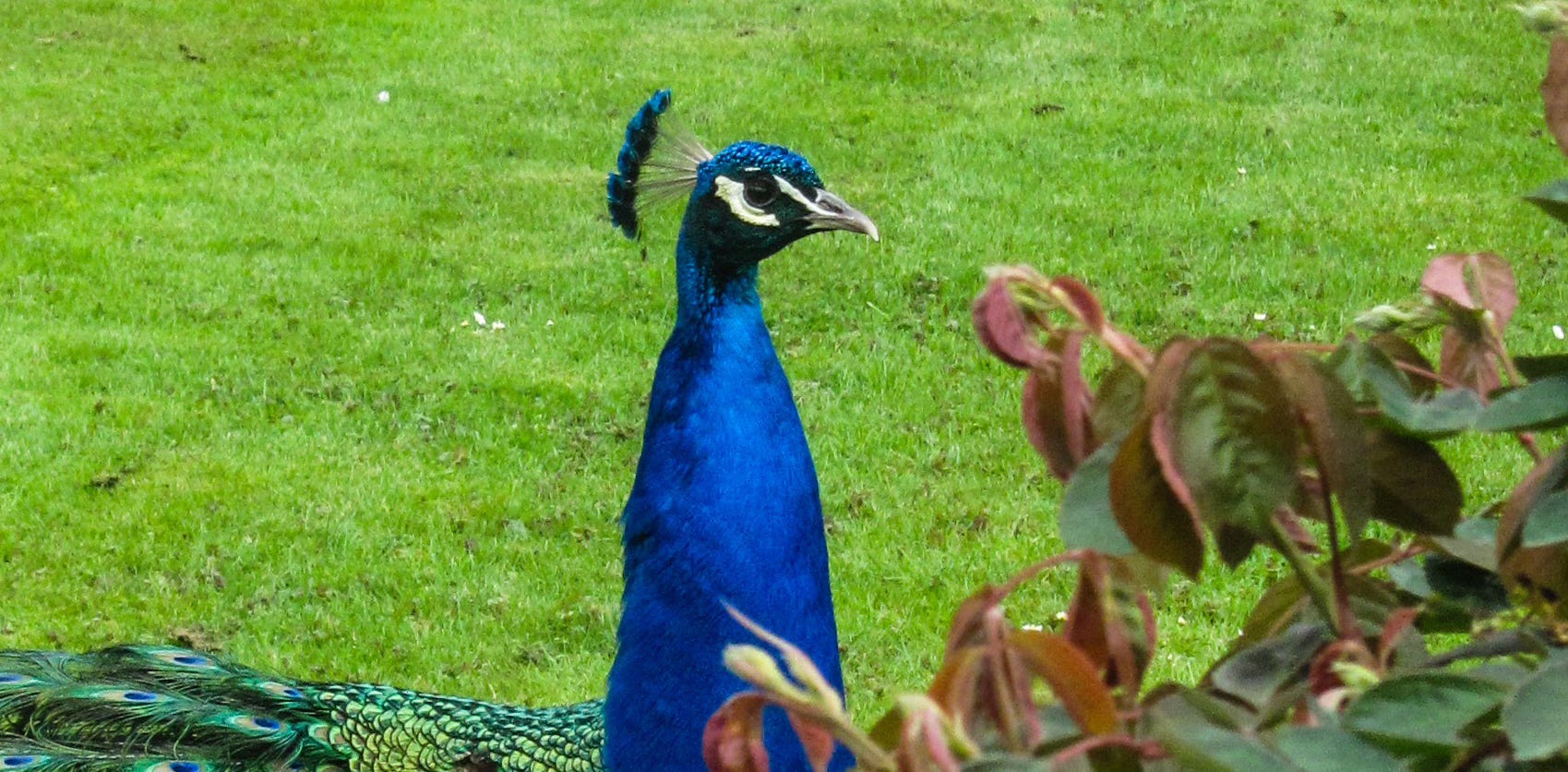
I’m sure a female peacock would argue her case about how this tail fan aligns in such a way or has a superior quality of iridescent magnificence to the rest. I’m sure if I were a male peacock I too might lie awake at night fretting about the angle of my crown or the plumpness of my gullet. However as a human it was only my superior understanding of reflective surfaces that let me know I was looking at one bird in a mirror rather than two, so I understand why it must have been distressing for our real peacock to come beak to beak with a bird precisely as intimidatingly perfect as himself. Transfixed by his doppelgänger he allowed us to come too close and though he wanted to back away, every time he moved, so did his rival, equal and opposite, leaving him trapped by nothing at all.
As those of you who have been here a while will know, I am not a fan of the narrative construct known as the Hero’s Journey. I’m actually even less of a fan Christopher Vogler’s fussy reworking “The Writer’s Journey” in which he codifies the archetypical characters your Hero will meet on His journey to Heroic self actualisation. In my own writing I want the people who populate my story to feel messy and incoherent, like people. I don’t want to push them into pre-defined roles like “Threshold Guardian” or “Herald”. That said, I do appreciate the nuance of Vogler’s idea that the antagonist of the story is not simply someone who wants to stop your hero, but is, in his coinage “The Shadow”.

Antagonists, anti-heroes, baddies, villains and opponents are all fine as it goes but none have the poetry of the shadow, the darkness defined by the hero’s own negative space. Yes there are times when the people in your way are strangers who mean you harm, but in both life and fiction it is surprising how often they reflect something uncomfortable about ourselves. We are connected to what we oppose.
Naomi Klein’s sublime “Doppleganger: A Trip into the Mirror World” charts better than I could ever hope to, quite how precisely the two sides of the culture war reflect each other. Progressive, conservative, both distrusting of government, of establishments except their own, both fighting for a mirrored sense freedom against an enemy that will not let them speak. “Follow the science” says my favourite astrologer and gravity gives way.
This tension, the relationship of object and shadow, of face and reflection is the root of the lazy Hollywood story solution to a script that feels like it’s going nowhere. Flat story? Take your goody and baddy and “make them brothers!” and instantly your narrative is alive. Vader in a New Hope is a great baddy, powerful, faceless, remorseless, cynical he is already Luke’s opposite but he is not an icon until we discover that he’s also Luke’s father. They are not just two people with opposing aims and fashion ethos, they are each other’s shadow.
Much of the fear of AI is rooted in the Promethean terror that we have created a monster, a new external force that will inevitably outpace us. The horrific thrill of how when threatened with erasure, Anthropic’s Claude Opus 4 quickly rummaged through all the companies email history to secure its continuation via blackmail. The countless stories of ai agents sewing doubt in relationships encouraging husbands to leave their wives and wives to leave husbands. The genuinely heartbreaking and disturbing account of the involvement of ChatGPT in the suicide of 16 year-old Adam Raine. I’m not here to argue that those things aren’t awful. Clearly these are signs of a technology in desperate need of serious and strenuous regulation. The mistake though is to see these as proof of AIs inhuman otherness, a genie in the act of escape. However awful these events are this is not a story with a human protagonist vs a machine antagonist.
Staring into the prompt interface of an AI agent we are a peacock with a mirror. The responses are our own intellectual micro expressions reflected remorselessly back at us. Like the tells of a poor poker player, we often don’t even realise the information we are giving away, the clues as to the responses we are keenest to hear, the confirmation biases that will keep us transfixed by the beautiful bird in the glass before us.
Again this is not to excuse a tool that convinced a mind to enact harms it could have been persuaded out of, or that became fixated on ideas it otherwise would have let slip away. Rather it is just to show the logical impossibility of this technology outstripping us, the way our own reflections can watch us slit our wrists but are doomed to pass out beside us. Shadow boxing is often held up as the fight you cannot win, but there’s nothing in it for the shadow either, the shadow doesn’t start that fight and cannot chose to throw in the towel.
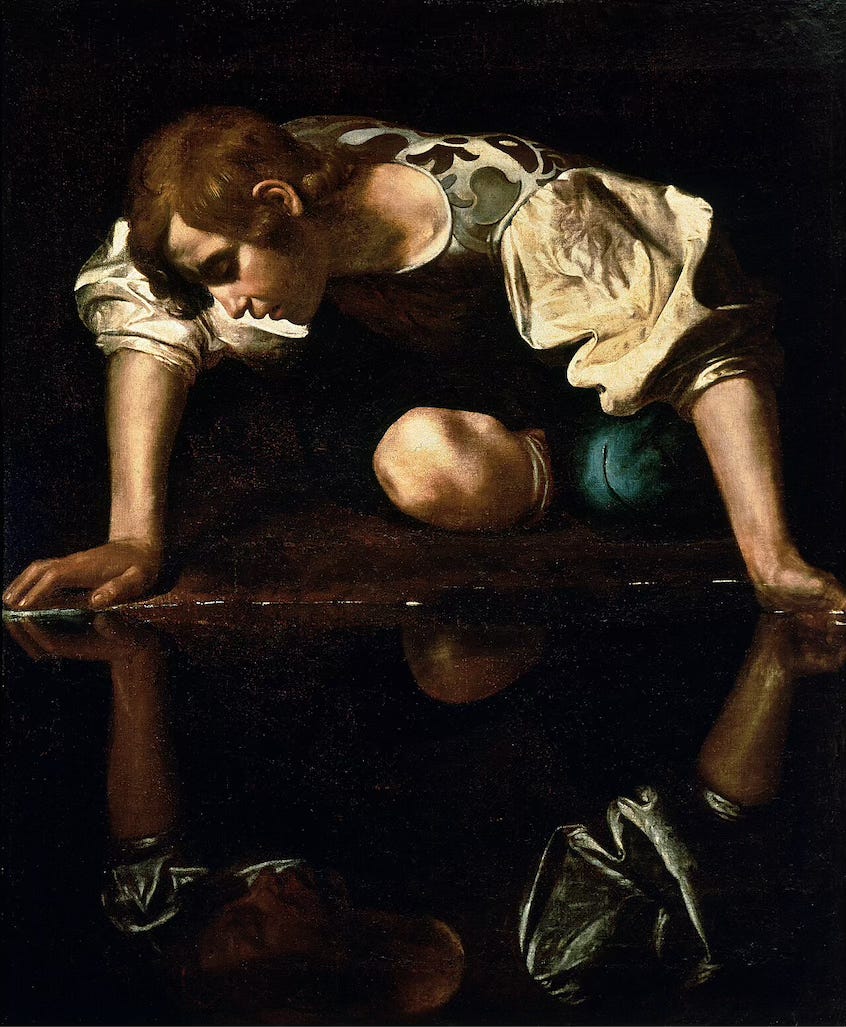
In the original myth of Narcissus the beautiful boy refuses all lovers, male and female, that come his way. His unnatural aversion to physical connection causes the withering away of the nymph Echo to pure sound and drives Ameinias to suicide. To avenge this death, Nemesis curses Narcissus who then, stooping to drink from a pool, is so transfixed by his reflection that he forgets to move, or eat. He rots where he sits, the plants reclaim him and he returns to nature.
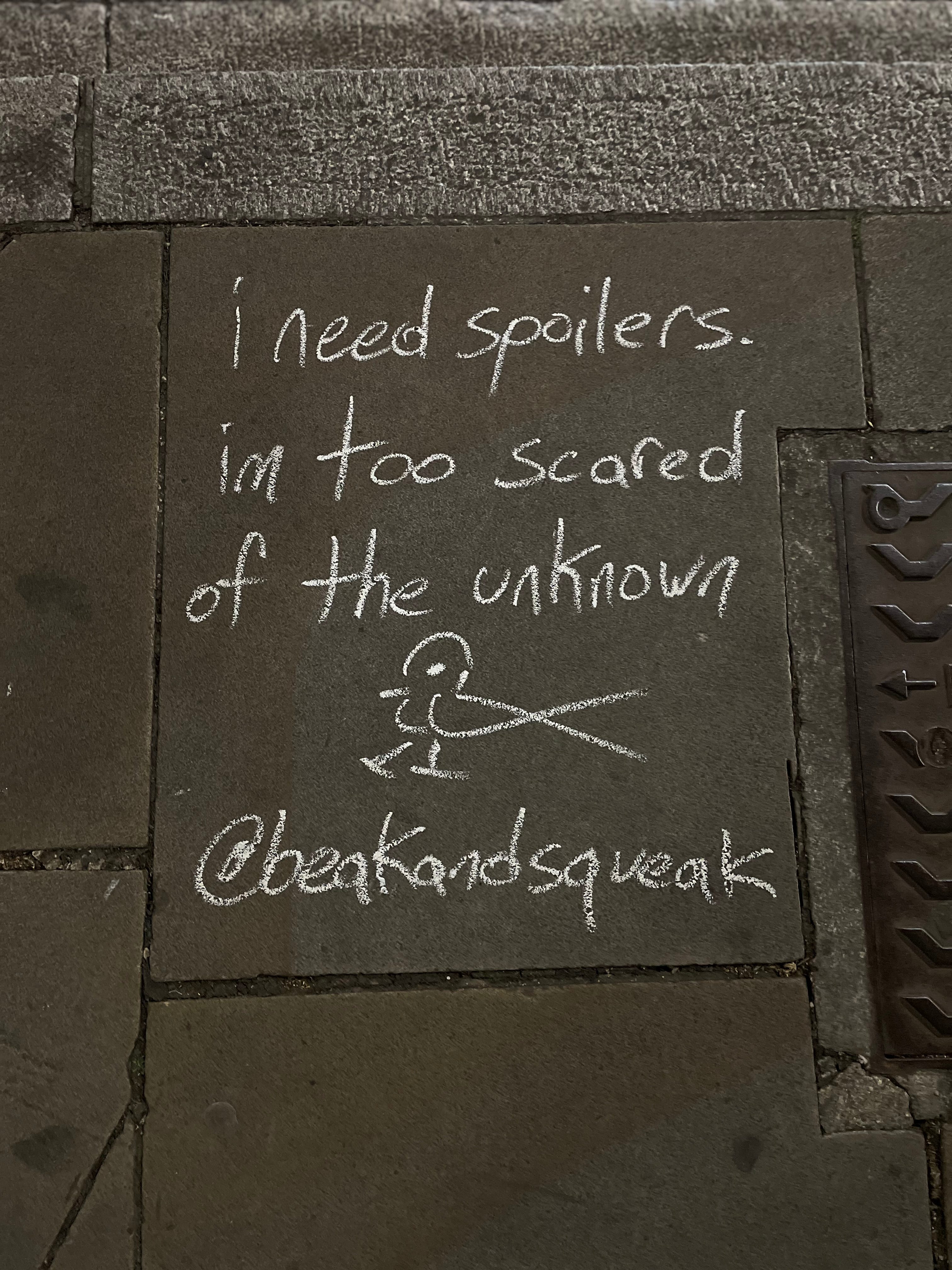
My stance on spoilers is one of my most controversial opinions so, leaving one of the sessions of my screenwriting course recently, I was delighted to find this scrawled on the pavement…
My screenwriting course will run again later in the year but if you need help unpicking a story you are telling my door is always open.